
Enrichment is often treated as a “nice-to-have.” In practice, it is one of the most effective welfare tools you can use for birds and reptiles in a home environment.
When enrichment is consistent, many animals show more natural behaviours such as foraging, exploring, basking appropriately, problem-solving, and settling calmly. Those behaviours influence appetite cues, sleep quality, body condition, and long-term stress.
From the perspective of holistic vet care, enrichment is not separate from health. It is part of health, because behaviour, husbandry, and physiology are always linked.
The challenge is that many households approach enrichment in a scattergun way. A new toy appears, a branch goes in, a puzzle feeder is offered once, then life gets busy and the routine fades.
The good news is that you can build a simple, repeatable system that works. It does not require expensive gear, and it can be adapted to your species, your home, and your schedule.
Why enrichment is health care, not just play
Chronic, low-grade stress is a common but often hidden problem in captive exotic pets. It may not look dramatic, but over time it can affect appetite, immunity, recovery from illness, and resilience to change.
In birds, signs can include feather damaging behaviour, increased screaming, reduced curiosity, or a lower tolerance for routine disruptions – and understanding the science behind exotic animal behaviour helps you spot what’s normal versus what needs attention.
Good enrichment provides three things that matter clinically: choice, control, and appropriate challenge. These reduce learned helplessness and support confidence, which is why animals that can engage in natural, self-directed behaviours often cope better with seasonal shifts and minor husbandry disruptions.
Holistic vets often talk about foundations first. Alongside nutrition, environment, and routine, enrichment sits firmly in that foundations group because it supports the whole animal rather than chasing a single symptom.
The enrichment traps most owners fall into
The first trap is choosing enrichment that looks fun to humans rather than matching instinct – which is why a simple set of behavioural enrichment foundations usually works better than random novelty. A bird may receive a colourful toy that offers no foraging payoff, no shredding outlet, and no “job” to complete.
A reptile may get a new decoration that reduces usable space, blocks part of the heat gradient, or changes the enclosure in a way that feels unsafe. When the pet avoids it, the owner concludes the animal “is not interested,” when the issue is a mismatch of function.
The second trap is inconsistency. Even excellent enrichment has limited impact when it appears randomly, because animals learn patterns and respond to predictability.
The third trap is doing too much at once. Sudden large changes can stress timid birds and many reptiles, and stress can hide behind “quiet” behaviour that is actually avoidance.
A simple rule helps here: introduce changes gradually and let the animal decide the pace. Enrichment works best when the animal has the option to engage, not the pressure to cope.
Species-specific enrichment ideas that fit natural behaviour
Birds and reptiles do not need the same type of stimulation, and they do not benefit from the same “toy culture” that people are used to with dogs and cats. The goal is not constant activity, it is a healthy behavioural range.
A useful test is this: does the activity encourage a natural behaviour, and can the animal return to calm routine afterwards? If yes, you are usually on the right track.
Enrichment for birds
Bird enrichment should be built around foraging, shredding, climbing, chewing, and appropriate social interaction. Even very tame birds remain wired to work for food and to manipulate their environment.
Safety first: choose bird-safe materials only (untreated paper, plain cardboard, stainless steel, natural fibre rope designed for birds), and avoid anything with zinc, lead, gluey residues, loose threads, or small parts that can be swallowed. If you use branches, make sure the plant species is known to be safe for that bird, pesticide-free, and scrubbed then thoroughly dried before use to reduce mould and bacterial risk. Check setups daily for fraying, sharp edges, and choking hazards, and remove anything that is becoming damaged.
When everything arrives in a bowl with no effort required, boredom and frustration become more likely. For many birds, especially parrots, daily “work” is a welfare need, not a luxury.
Simple options that often work well include food puzzles, safe scatter-feeding, rotating browse branches, and small “jobs” that take time to complete. Think of enrichment as a series of short, repeatable challenges that end with a reward.
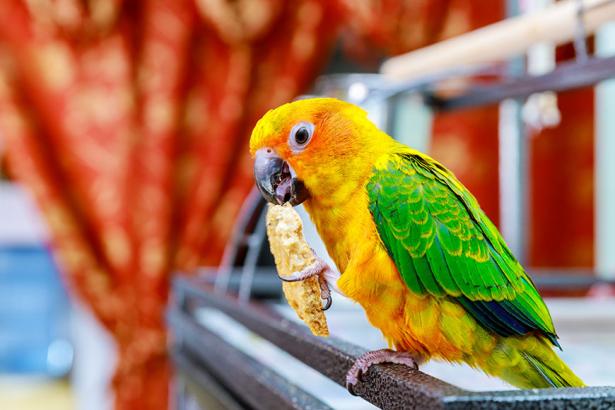
- Parrots (including lorikeets, conures and cockatoos) usually respond best to “foraging you can destroy” – paper-wrapped parcels, cardboard cups, and skewer-style foraging that ends with a clear reward – and it’s worth reading why parrots make terrible pets unless you’re ready for the long-term commitment.
- Budgies and cockatiels often prefer lighter, smaller-scale enrichment – shallow scatter-feeding trays with safe dried herbs/greens, thin safe browse, and simple “search zones” rather than heavy puzzle devices.
- Birds that are prone to feather damaging behaviour often do better with predictable daily foraging stations plus a rotating shred option, rather than lots of brand-new toys introduced at once.
Movement also matters. If out-of-cage time drops in winter or during busy weeks, build activity into the cage with climbing routes, perch variety (diameters and textures), and foraging stations that encourage movement rather than sitting. Review our winter care tips if seasonal changes are affecting routine.
If you use natural branches, ensure they are safe and pesticide-free, and avoid unknown plant species. Sourcing safe native browse can be helpful, but it should always be done with species safety in mind and practical hygiene.
Enrichment for reptiles
Reptile enrichment is often misunderstood because reptiles do not “play” in the mammal sense. For reptiles, enrichment is more about supporting natural movement patterns, exploration, species-appropriate hunting or feeding behaviours, and effective thermoregulation.
Safety first: keep your heat gradient and UV setup stable, and avoid moving or blocking basking zones, UV lamps, or thermostats when you add novelty – because poor lighting and heat are major risk factors for metabolic bone disease. Any new item should be easy to clean, non-toxic, and free of loose fibres or small pieces that could be ingested with food, especially in species that strike and swallow quickly. Clean and dry enrichment items between uses to reduce parasite and bacterial load, and introduce changes gradually so the reptile can keep using its hides, basking site, and temperature range without disruption.
A reptile that is enriching itself well will still bask, still use the heat gradient, still feel secure, and still settle into calm rest after exploring. The aim is not constant activity, it is confident normal behaviour.
Practical options can include small layout changes, adding new textures or hides, providing safe climbing opportunities for arboreal species, and setting up feeding routines that involve searching rather than immediate presentation. For some species, scent trails or novel objects introduced gradually can encourage exploration without tipping into stress.
- Bearded dragons often benefit from “route changes” – a safe basking-to-cool side pathway using textured surfaces and a new intermediate perch, while keeping the basking temperature and UV position unchanged.
- Blue-tongue lizards tend to do well with low-risk novelty – an extra hide with a different texture, a shallow dig box, or a feeding pattern that encourages slow searching rather than immediate bowl feeding.
- Arboreal lizards generally respond to vertical complexity – additional stable branches or platforms that encourage climbing without removing their preferred secure resting spot.
The key is to protect the basics first. Heat gradient, UV settings where appropriate, access to secure hides, and stable day-night cues should remain consistent, even when you add variety.
The simple tracking system that makes enrichment consistent
A good enrichment system has two parts: a schedule and a log. The schedule builds consistency, and the log makes the system smarter over time.
Start with a rhythm you can genuinely maintain. For many households, a three-day rotation is realistic and effective.
Day 1 can be foraging-focused. Day 2 can be habitat or movement-focused. Day 3 can be interaction-focused for birds, or low-disturbance enrichment for reptiles.
Your log does not need to be complicated, and it does not need to be “perfect.” The goal is to notice patterns and build a baseline of normal behaviour.
For birds, record what you offered and note engagement time, mood, vocalisation changes, droppings consistency, and any obvious stress signs. For reptiles, note basking behaviour, exploration, feeding response, and whether the animal settled normally afterwards.
Over time, this baseline becomes one of the most useful tools you have. It makes it easier to spot meaningful change early, and it reduces guesswork when you are trying to improve wellbeing.
How to tell if enrichment is helping or stressing your pet
The most reliable check is what happens after the activity. Healthy enrichment is usually followed by calm settling and predictable routine.
Stressful enrichment often triggers prolonged hiding, refusal to bask, agitation, avoidance that lasts beyond the session, or behaviour that looks “busy” but is actually unsettled.
For birds, red flags include sudden fear responses, persistent screaming, aggression that is out of character, or withdrawing from normal social contact. For reptiles, red flags include abandoning the basking zone, repeated food refusal, frantic glass-surfing that persists, or excessive hiding beyond the animal’s usual pattern.
A practical rule is “challenge, not chaos.” You want the animal thinking and choosing, not panicking.
If you see stress signs, scale the enrichment down. Simplify it, reduce novelty, and introduce changes more gradually.
Enrichment links to appetite, weight, and long-term wellness
Diet matters, but behaviour and routine matter too – and our exotic pet nutrition guide is a good companion read when you’re building a whole-picture plan. A bird that forages naturally is less likely to eat rapidly and then sit inactive, and more likely to maintain steady activity through the day.
A reptile that explores and thermoregulates appropriately is more likely to digest well, show stable appetite cues, and maintain predictable stool patterns. When basking becomes inconsistent, digestive changes often follow, and appetite often changes with them.
Tracking makes these connections visible. When enrichment drops off, weight can creep up in some birds due to reduced movement, while other individuals may lose weight if stress rises.
This whole-picture view is a core part of a holistic vet approach. Better outcomes usually come from steady routines that support natural behaviour, not from isolated tweaks made once and then forgotten.
A weekly enrichment plan you can actually maintain
If you want a starting point, keep it simple and repeatable. The goal is consistency first, then variety.
Day 1: Foraging focus
For birds, make food safely harder to access using puzzle feeders, paper-wrapped parcels, or scatter-feeding appropriate items. For reptiles, use a species-appropriate feeding routine that encourages searching or movement rather than immediate presentation.
Day 2: Habitat and movement focus
For birds, rotate a safe branch, adjust perch positions, or create a new climbing route. For reptiles, make a small enclosure change that encourages exploration while keeping the heat gradient stable.
Day 3: Interaction or low-disturbance focus
For birds, short training sessions, gentle skill-building, and predictable social time can be enrichment in itself. For reptiles, keep handling minimal unless it is part of safe habituation, and focus on low-stress environmental changes.
Repeat the cycle and keep brief notes. Over time you will learn what your animal genuinely seeks out, what it avoids, and what supports calm confidence.
When to speak with a vet
If your bird or reptile shows a persistent change in behaviour, appetite, droppings, weight, or breathing, treat it as a health question first. Enrichment is powerful, but it is not a substitute for medical assessment when something is truly wrong.
A consult with a vet who sees exotic pets regularly can help identify whether the issue is husbandry, stress, diet, disease, or a combination. In many cases, small targeted changes make a big difference, especially when concerns are caught early.
The steady routine that builds resilience
Exotic pets tend to thrive on stability, choice, and appropriate challenge. When enrichment is consistent and species-appropriate, it supports behaviour, welfare, and long-term health.
If you build a simple schedule, keep a short log, and look for calm settling after enrichment, you will develop a system that improves wellbeing without guesswork. That is good husbandry working hand-in-hand with holistic vet care.
Ready to start? Download our simple enrichment tracker or book a consultation today.
FAQs
Helpful enrichment is usually followed by calm settling and normal routine. Stressful enrichment often leads to prolonged hiding, refusal to bask, agitation, persistent avoidance, or behaviour that looks busy but doesn’t resolve.
Stick with bird-safe options like untreated paper, plain cardboard, stainless steel, and bird-safe natural fibre items. Avoid anything that can fray, splinter, or be swallowed, and avoid metals like zinc or lead and unknown plants that may be toxic.
Yes. Reptile enrichment is about encouraging natural behaviours such as exploration, climbing (for arboreal species), hunting or searching routines, and appropriate thermoregulation, while keeping heat and UV stable.
Small, gradual changes can be beneficial, but keep the heat gradient, basking zone, hides, and UV setup consistent. Big rearrangements can create insecurity and may lead to hiding, reduced basking, and appetite changes.
It can be, provided it’s species-appropriate and doesn’t create choking risks, contamination, or overeating. Use safe presentation methods, keep items clean and dry, and adjust portions so enrichment supports healthy body condition rather than adding excess calories.
Reduce novelty, simplify the setup, and introduce one change at a time. Focus on predictable foraging-based enrichment and watch for calm settling afterwards, and if the change persists or escalates, treat it as a behavioural and health question rather than “bad behaviour.”
If you notice persistent changes in appetite, droppings, weight, breathing, energy, basking patterns, or behaviour, get a veterinary assessment. Enrichment supports wellbeing, but it should not delay medical care when something may be wrong.